

Blog
A Few Things Worth Knowing Before You Buy Any Supplement

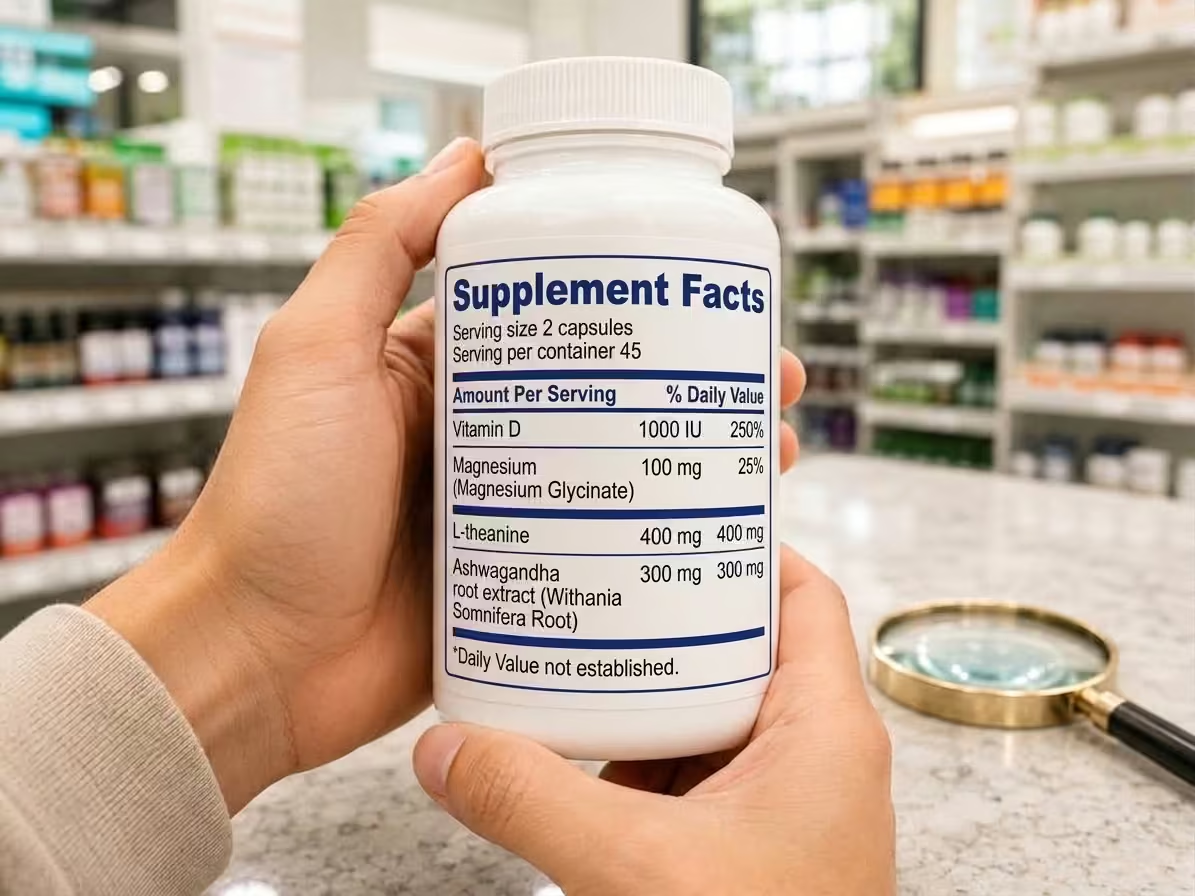
Supplement shelves are crowded, and the labels don’t make it easy. Bold words on the front, a wall of ingredient names on the back, and not much in between to help you figure out whether a product is actually worth buying. This post isn’t about any one product, ours included; it’s a starting point for reading a supplement label the way it deserves to be read, whichever brand you end up choosing.
It’s easy to skim past a label without really looking at it. The front of the bottle is designed to be skimmed for a word like “calm” or “energy,” a clean photo, maybe a badge or two. The information that actually helps you decide anything is almost always on the back, in smaller print, and it takes a bit more patience to work through. That patience tends to pay off.
Supplements aren’t regulated the way medicine is
People often assume that a product sold in a bottle with a “Supplement Facts” panel has undergone the same level of testing as a prescription drug. It hasn’t. In the U.S., the FDA does not evaluate dietary supplements before they reach store shelves, and federal law prohibits manufacturers from claiming that supplements diagnose, treat, cure, or prevent any disease. That’s true across the entire category, not a flaw specific to any one company.
This distinction matters because it shifts where the responsibility sits. With a prescription medication, a regulatory body has reviewed the evidence before it ever reaches you. With a supplement, that review largely hasn’t happened in the same way, which means more of the evaluation falls to the person buying it. That’s not necessarily a bad thing; it just means a little more homework is useful before adding something new to a routine.
This isn’t a reason to avoid supplements. It’s a reason to read a little more carefully than you might with something more tightly regulated, and to treat confident-sounding language on a label with a bit of healthy skepticism rather than taking it at face value.
Check whether ingredients are listed individually
One of the most common things to watch for is a “proprietary blend,” a line on the label listing several ingredients together under one combined weight, with no individual amounts given. It’s legal, and it’s common, but it also means there’s no way to know how much of any single ingredient you’re actually getting. A blend could lean heavily on a cheap filler and only lightly on the ingredient that matters. The label alone won’t tell you.
A product that lists each ingredient with its own specific amount gives you something a blend doesn’t: the ability to actually compare it to what’s been studied. That single difference, individually listed ingredients versus a combined blend, is often the fastest way to sort a more transparent label from a less transparent one, before reading anything else on the package.
It’s also worth noticing the order in which ingredients appear. Ingredients are generally listed by weight, from most to least. If a blend’s marquee ingredient, the one mentioned on the front of the bottle, appears near the bottom of a long list, that’s worth a second look.
Dose matters more than the ingredient name
Seeing a recognizable ingredient on a label, magnesium, ashwagandha, turmeric, doesn’t tell you much by itself. Most supplement research examines specific dose ranges and, in some cases, specific forms of the ingredient. An amount well below what’s typically studied may not do much, even if the ingredient itself is legitimate.
Form matters here too. The same ingredient can appear in different chemical forms with different absorption profiles. Magnesium glycinate and magnesium oxide are both “magnesium,” for instance, but they’re not interchangeable in terms of how the body absorbs and uses them. A label that only says “magnesium” without specifying the form is giving you less information than one that’s specific about it.
This is a place where it’s worth doing a little independent digging rather than taking a label’s word for it. Searching for the ingredient and its studied dose range is usually enough to get a general sense of whether a product’s amount is in a reasonable ballpark. It takes a few extra minutes, but comparing doses is one of the most reliable ways to distinguish a thoughtfully dosed product from one designed to hit a price point.
“Third-party tested” should be checkable
The phrase “third-party tested” shows up often, but it’s worth knowing what it’s supposed to mean: an independent lab, separate from the manufacturer, verifying that a product contains what it claims (potency) and is free of contaminants (purity). Manufacturers usually document that verification in a Certificate of Analysis, or COA.
The phrase on its own isn’t much to go on. Anyone can print “third-party tested” on a label; what matters is whether a brand can actually produce documentation to back it up. A brand willing to make that information available, batch by batch, is signaling something different than one that treats the phrase as a marketing checkbox.
If you’re comparing two products and one offers a way to view or request testing documentation while the other simply states the phrase and moves on, that gap is worth weighing.
“GMP certified” is about the facility, not the formula
GMP stands for Good Manufacturing Practice, and GMP-certified facilities are expected to follow standards around cleanliness, equipment, staff training, and batch record-keeping. It’s a real standard, but it’s worth being clear about what it doesn’t cover: it says nothing about whether a specific formula works, and it isn’t an FDA approval of the product itself. It’s a manufacturing-quality signal, not a claim about effectiveness.
In other words, GMP certification tells you how consistently a manufacturer makes a product, but it does not tell you what the product contains or whether the doses make sense. It’s worth knowing, but it isn’t a substitute for checking the ingredient list and dosages directly.
Watch for language that sounds more certain than it should
Certain phrases tend to show up on labels and in marketing copy precisely because they sound authoritative without saying much: “clinically proven,” “doctor-formulated,” “miracle,” “guaranteed results.” None of these are meaningless by definition, but none of them are self-verifying either. “Clinically proven” should raise the question of which study, on what population, at what dos,e and whether that dose matches what’s actually in the bottle.
A general rule of thumb: the more definite a supplement’s language sounds, the more worth double-checking it becomes. Careful, hedged language such as “may support” or “is generally associated with” often reflects the reality of supplement research more honestly than claims that sound airtight.
Supplements support; they don’t replace
Even a well-made, well-dosed, transparently labeled supplement is still a supplement, something meant to support a general goal, not treat a condition or replace medical care. If you’re pregnant, nursing, under 18, managing a health condition, or taking prescription medication, that’s a conversation for a doctor or pharmacist before adding anything new, not something a label or a blog post can settle for you.
It’s also worth remembering that “natural” doesn’t automatically mean “risk-free.” Supplement ingredients can interact with medications or existing conditions, even when they come from plant or food sources. A pharmacist is often a quicker and more accessible resource for this kind of question than people expect. Many are happy to check a supplement against an existing medication list.
A short list worth keeping in mind
Next time you’re comparing supplements, a few questions tend to cut through most of the marketing:
- Are ingredients and doses listed individually, or hidden inside a blend?
- Do the amounts look reasonable compared to what’s generally studied?
- Can the brand produce a real Certificate of Analysis, not just the phrase “tested”?
- Is the manufacturing facility disclosed?
- Does the label avoid making disease-related claims that the law prohibits?
- Does the marketing language sound more certain than the underlying research probably is?
None of these require special expertise, just a willingness to read past the front of the bottle, and a habit of asking the same handful of questions regardless of how appealing the packaging looks.
Building the habit
None of this needs to happen every single time you restock something you already trust. But for anything new, a product you haven’t tried, a category you’re less familiar with, running through these questions once is usually enough to get a reasonably clear picture. Over time, it stops feeling like extra work and starts feeling like the normal way to look at a label.
It also helps to keep a mental note of what you’ve already checked. If you’ve looked closely at a product, once confirmed the doses, found the testing documentation, and understood the form of each ingredient, you don’t need to redo that work every time you reorder. The effort front-loads: it’s heaviest the first time you’re deciding whether to trust a brand, and lighter after that, as long as nothing about the formula changes. Reformulations do happen, though, so it’s worth glancing at the label again if a product’s packaging or ingredient list looks different from what you remember.
Why this is worth the extra few minutes
It can feel like a lot of steps for something as small as a vitamin or a sleep aid. But the amount of money and, more importantly, the amount of trust involved in a supplement purchase is often larger than it first appears, especially for something taken daily, over months or years. Spending a few minutes comparing a label against a handful of consistent questions costs little, while the habit helps you make better choices with every future purchase, not just the one in front of you.
Frequently asked questions
Is a higher price a reliable sign of a better supplement?
Not on its own. Price can reflect ingredient quality, dosing, or third-party testing costs, but it can just as easily reflect packaging, marketing spend, or brand positioning. It’s more useful as one data point alongside the label checks above than as a shortcut by itself.
Do more ingredients on a label mean a better product?
Not necessarily. A long ingredient list can indicate a well-rounded formula, or the manufacturer may include several ingredients at doses too small to matter simply to feature them on the front of the bottle. The dose behind each ingredient tends to matter more than the length of the list.
Is “natural” the same as “safe”?
No. Natural sourcing says something about where an ingredient comes from, not about its dose, its interactions with medications, or its appropriateness for a given person. Plenty of naturally derived compounds can still interact with health conditions or medications.
How can I tell if a dose is actually meaningful?
Generally, by comparing it to the dose ranges used in published research on that ingredient. This takes a short search, but it’s one of the more reliable ways to tell a meaningfully dosed product from one that includes an ingredient mostly for the label.
What’s the difference between a Supplement Facts panel and a Certificate of Analysis?
The Supplement Facts panel is what’s printed on the product itself, listing ingredients and amounts as formulated. A Certificate of Analysis is a separate lab document confirming what a specific batch actually contained after testing. The panel reflects intent; the COA reflects verification.
Should I be wary of a supplement that makes health claims like “treats” or “cures”?
Generally, yes. The law bars dietary supplements from claiming that they diagnose, treat, cure, or prevent disease. When a label or ad makes those claims anyway, take it seriously—it may signal a legal red flag or show that the marketing promises more than the product can actually deliver.
Is it fine to ask a brand directly for testing documentation?
Yes, and it’s a reasonable thing to expect a straightforward answer to. A brand’s willingness to share that information, and how easily it does so, tells you something about how seriously it takes the claims on its own label.
A note on this blog
We’re not a medical practice, and nothing here should replace advice from your doctor or pharmacist. When research is limited or mixed, we clearly explain the uncertainty instead of overstating the evidence.
We wrote this post to be useful whether or not you ever buy anything from us; the same questions matter no matter whose bottle you’re holding.
If there’s a specific ingredient or topic you’d like covered next, you can reach out through our contact page. Reader questions are a real part of what shapes what we write about going forward.
Dietary supplements are not intended to diagnose, treat, cure, or prevent any disease and have not been evaluated by the FDA. Consult a qualified healthcare professional before use, especially if you are pregnant, nursing, under 18, or taking prescription medications.