

Vitamin D3 and K2 Benefits: Solving the Calcium Paradox for Stronger Bones and a Healthy Heart

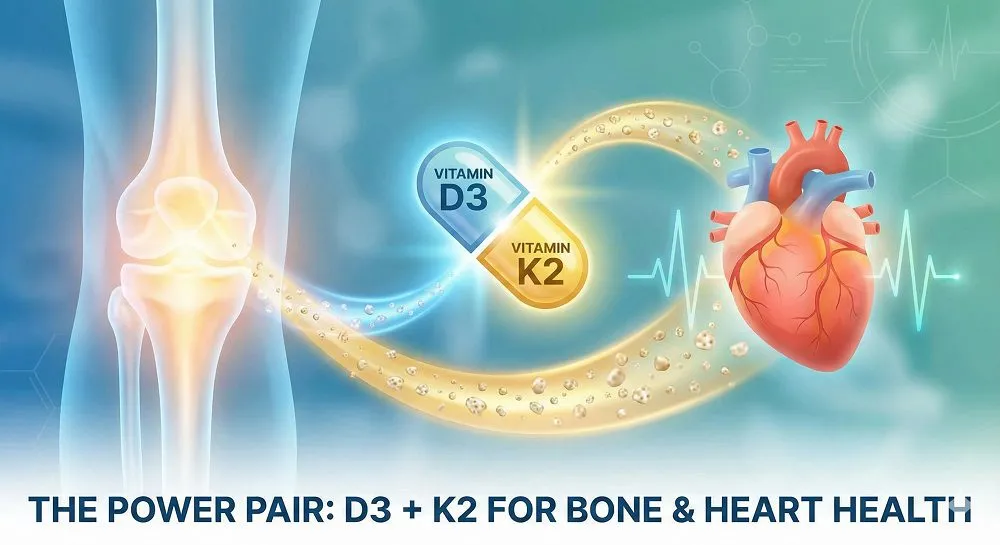
You might be taking Vitamin D daily to protect your bones. But without its essential partner, that same habit could be silently damaging your heart.
Millions of people supplement with Vitamin D3 to prevent osteoporosis. However, recent data suggests that D3 alone can increase calcium levels in the blood without guiding it to the skeleton. This misdirected calcium often ends up in the arteries, leading to calcification and stiffness.
This is the Calcium Paradox: You have too much calcium in your arteries and not enough in your bones.
The solution isn’t to stop taking Vitamin D. The solution is Vitamin K2.
At Zenvitaco.com, we understand that nature works in pairs. This guide explains why D3 and K2 must be taken together and how this synergy protects your heart while building a stronger skeleton.
What Is the Connection Between Vitamin D3 and K2?
Think of Vitamin D3 and K2 as a construction team.
Vitamin D3 is the “Gatherer.” It acts as the gatekeeper, absorbing calcium from the food you eat and pulling it into your bloodstream. Without D3, your body passes most calcium out as waste.
Vitamin K2 is the “Traffic Cop.” Once the calcium is in your blood, K2 directs it where to go. It signals the calcium to move into the bone matrix (where you want it) and away from soft tissues like arteries and kidneys (where you don’t).
Without the “Traffic Cop” (K2), the “Gatherer” (D3) floods the system with building blocks that have nowhere to go. This biological mismanagement is the root cause of many modern calcium-related health issues.
Understanding the Calcium Paradox: When Good Nutrients Go Bad
The Calcium Paradox describes a confusing medical reality: A person can suffer from osteoporosis (weak bones) and atherosclerosis (hardening of the arteries) at the same time.
For years, doctors couldn’t explain why calcium supplements seemed to increase heart attack risks in some patients. The missing link was Vitamin K2 deficiency.
When you take high doses of D3 or Calcium without K2:
-
Calcium enters the blood efficiently.
-
Proteins required to move calcium into bone remain inactive.
-
Calcium settles in the arterial walls, forming plaque.
-
Arteries become stiff, increasing blood pressure and heart disease risk.
Zenvitaco formulates supplements specifically to break this cycle, ensuring your nutrients work for you, not against you.
The Science of Synergy: How They Work Together (MGP & Osteocalcin)
This isn’t magic; it’s biochemistry. Vitamin K2 works by activating two specific proteins that are already present in your body but dormant.
1. MGP (Matrix Gla Protein): The Artery Protector
MGP is the most potent inhibitor of vascular calcification known to science. It lives in your arterial walls.
-
Without K2: MGP remains inactive (uncarboxylated). It cannot stop calcium from sticking to the vessel walls.
-
With K2: MGP is activated (carboxylated). It actively sweeps calcium out of soft tissues and arteries.
2. Osteocalcin: The Bone Builder
Osteocalcin is a protein secreted by osteoblasts (bone-building cells).
-
Without K2: Osteocalcin cannot bind to calcium. The mineral floats freely in the blood.
-
With K2: Osteocalcin is activated to “grab” calcium molecules and bind them firmly into the bone matrix.
Top Benefits of Taking D3 and K2 Together
Combining these nutrients unlocks benefits that neither can achieve alone.
-
Superior Bone Density: Clinical trials show that combined supplementation slows bone loss in postmenopausal women more effectively than K2 or D3 alone.
-
Cardiovascular Protection: Studies suggest that adequate K2 intake is linked to reduced arterial stiffness and a lower risk of coronary heart disease.
-
Enhanced Immune Function: Vitamin D modulates the immune system, but K2 prevents the inflammation that often accompanies immune responses.
-
Dental Health: The same process that strengthens bones also remineralizes teeth, as Osteocalcin is active in dental tissue.
Dosage and Ratios: The Critical Difference
Not all Vitamin K2 is created equal. There are two main forms: MK-4 and MK-7. Understanding the difference is vital for effective supplementation.
Comparison: MK-4 vs. MK-7 (Menaquinone)
| Feature | Vitamin K2 (MK-4) | Vitamin K2 (MK-7) |
| Source | Synthetic or Animal Fat | Natural Fermentation (Natto) |
| Half-Life | Short (few hours) | Long (72+ hours) |
| Dosage Frequency | Requires multiple doses/day | Once daily is effective |
| Bioavailability | Low | High |
| Zenvitaco Choice | No | Yes |
The Golden Ratio:
Most experts recommend approximately 45mcg of K2 (MK-7) for every 1,000 IU of Vitamin D3.
For a standard maintenance dose of 5,000 IU of D3, you should look for 180-200mcg of K2.
The Zenvitaco Difference: Purity & Bioavailability
You can’t supplement your way out of a bad diet with low-quality ingredients. Many supplements use synthetic MK-4 because it is cheaper, even though it leaves your body within hours.
At Zenvitaco, we prioritize efficacy. Our specific formulation of Vitamin D3 + K2 for Bone & Heart Support uses all-natural Menaquinone-7 (MK-7) derived from fermentation.
This ensures the nutrient stays in your bloodstream long enough to activate MGP and protect your heart around the clock. We pair this with a lipid (fat) base to maximize absorption, as both D3 and K2 are fat-soluble vitamins. Don’t settle for “expensive urine”—choose a supplement designed for absorption.

Vitamin D3 K2 for Bone & Heart Support
Frequently Asked Questions (FAQ)
Why should you take Vitamin D3 with K2?
They work synergistically to regulate calcium.
While Vitamin D3 ensures calcium is absorbed into the bloodstream, Vitamin K2 acts as a “traffic cop,” directing that calcium into your bones and teeth. Without K2, calcium can deposit in your arteries, potentially leading to heart disease.
What is the Calcium Paradox?
A condition of simultaneous weak bones and clogged arteries.
This occurs when a person has a calcium deficiency in their skeleton (osteoporosis) but an excess of calcium in their arteries (atherosclerosis). It is largely driven by a lack of Vitamin K2, which is needed to transport calcium correctly.
Can I take Vitamin D3 without K2?
It is not recommended for long-term health.
High doses of Vitamin D3 increase calcium absorption. Without adequate Vitamin K2 to activate proteins like Matrix Gla Protein (MGP), this excess calcium may settle in soft tissues like kidneys and blood vessels instead of strengthening your bones.
Does Vitamin K2 unclog arteries?
It stops new buildup and may improve flexibility.
Research indicates Vitamin K2 inhibits the progression of arterial calcification. While it is the most potent nutrient for preventing new calcium deposits, studies are still investigating its ability to remove existing plaque entirely.
What is the best ratio of Vitamin D3 to K2?
Approx. 45mcg K2 per 1,000 IU D3.
For a standard daily dose of 5,000 IU of Vitamin D3, this equates to roughly 180-200mcg of Vitamin K2 (specifically the MK-7 form) to ensure optimal protection.
Ready to support your bones and heart properly?
Stop guessing with your health. Experience the synergy of high-quality ingredients with Vitamin D3 + K2 for Bone & Heart Support.
