

Who Actually Needs a D3 + K2 Supplement? (And Why 5000 IU Matters)


You’re tired. Your joints ache a little more than they used to. You catch every cold that goes around the office. You might assume this is just “aging” or “stress,” but often, it’s a simple biological gap.
We live indoor lives. We work in offices, exercise in gyms, and relax in living rooms. This modern lifestyle has created a massive, silent epidemic: Vitamin D deficiency.
But popping a standard Vitamin D pill isn’t always the fix. In fact, taking Vitamin D without its partner, Vitamin K2, can be ineffective or even risky.
Here is why the 5000 IU D3 + K2 combination is becoming the gold standard for modern health, and how to know if you are the prime candidate for it.
The “Calcium Paradox”: Why D3 Is Dangerous Without K2
Many people take Vitamin D for strong bones. It works by helping your body absorb calcium from your food. But once that calcium is absorbed, Vitamin D doesn’t control where it goes.
Without guidance, calcium can drift into your soft tissues, like your arteries and kidneys, causing calcification (hardening). It creates a dangerous paradox: your bones stay weak while your arteries get clogged with the very mineral meant to strengthen your skeleton.
Enter Vitamin K2: The Traffic Cop.
Vitamin K2 activates a specific protein called osteocalcin that grabs calcium and directs it into your bones. It also activates Matrix Gla Protein (MGP), which sweeps calcium out of your arteries.
- Vitamin D3: Opens the door for calcium.
- Vitamin K2: Guides calcium to the right room (bones, not arteries).
Taking them together isn’t just a bonus; it’s a biological necessity for safety and efficacy.
1000 IU vs. 5000 IU: Why Potency Matters
Walk into a drugstore, and you’ll see rows of 600 IU or 1000 IU bottles. For years, this was the standard recommendation. However, new research suggests these doses are often too low to correct an existing deficiency.
If you are already low on Vitamin D (which is likely if you work indoors), 1000 IU is barely enough to maintain your current low level. To actually raise your blood levels to the optimal range (40–80 ng/mL), a “corrective dose” is often required.
That “sweet spot” for many adults is 5000 IU (125 mcg).
Dosage Comparison: Maintenance vs. Correction
| Feature | Standard Dose (1000 IU) | High-Potency (5000 IU) |
| Primary Use | Maintaining already healthy levels. | Correcting a deficiency. |
| Target Audience | People with high sun exposure. | Indoor workers, older adults. |
| Impact Speed | Very slow (months to years). | Efficient (weeks to months). |
| Best For | Summer months. | Winter / Year-round support. |
The Checklist: 5 Signs You Are the Target Audience
Not everyone needs a high-dose supplement. But if you fall into one of these categories, your body is likely craving that D3 + K2 support.
1. The “9-to-5” Indoor Worker
If you arrive at work before the sun is strong and leave when it’s setting, you simply aren’t making Vitamin D. Glass windows block the UVB rays needed for production.7 Even if your desk is sunny, your skin isn’t producing the vitamin.
2. You Have Darker Skin
Melanin is natural sunscreen.8 While it protects skin from burning, it also significantly slows down Vitamin D production. People with darker skin tones may need up to 3-5 times more sun exposure than those with lighter skin to generate the same amount of Vitamin D.
3. Post-Menopausal Women (Bone Density)
Estrogen plays a key role in bone protection.9 As levels drop during menopause, bone density can plummet. This demographic is at the highest risk for osteoporosis. The K2 component here is critical to ensure calcium strengthens the skeletal matrix rather than stiffening the heart valves.
4. You Have Heart Health Concerns
If you are worried about arterial stiffness or blood pressure, K2 is your ally. By preventing calcium buildup in blood vessels, K2 supports arterial flexibility and cardiovascular health.10
5. You Rarely Eat Fermented Foods
Vitamin K2 is rare in the western diet. It is found mostly in fermented foods like Natto (fermented soybeans) or specific aged cheeses. If you aren’t eating Natto daily (and most people aren’t), you are likely deficient in K2.
Zenvitaco’s Advantage: The “One Veggie Capsule” Solution
Consistency is the hardest part of supplementation. Nobody wants to open three different bottles every morning to get their D3, their K2, and a fat source.
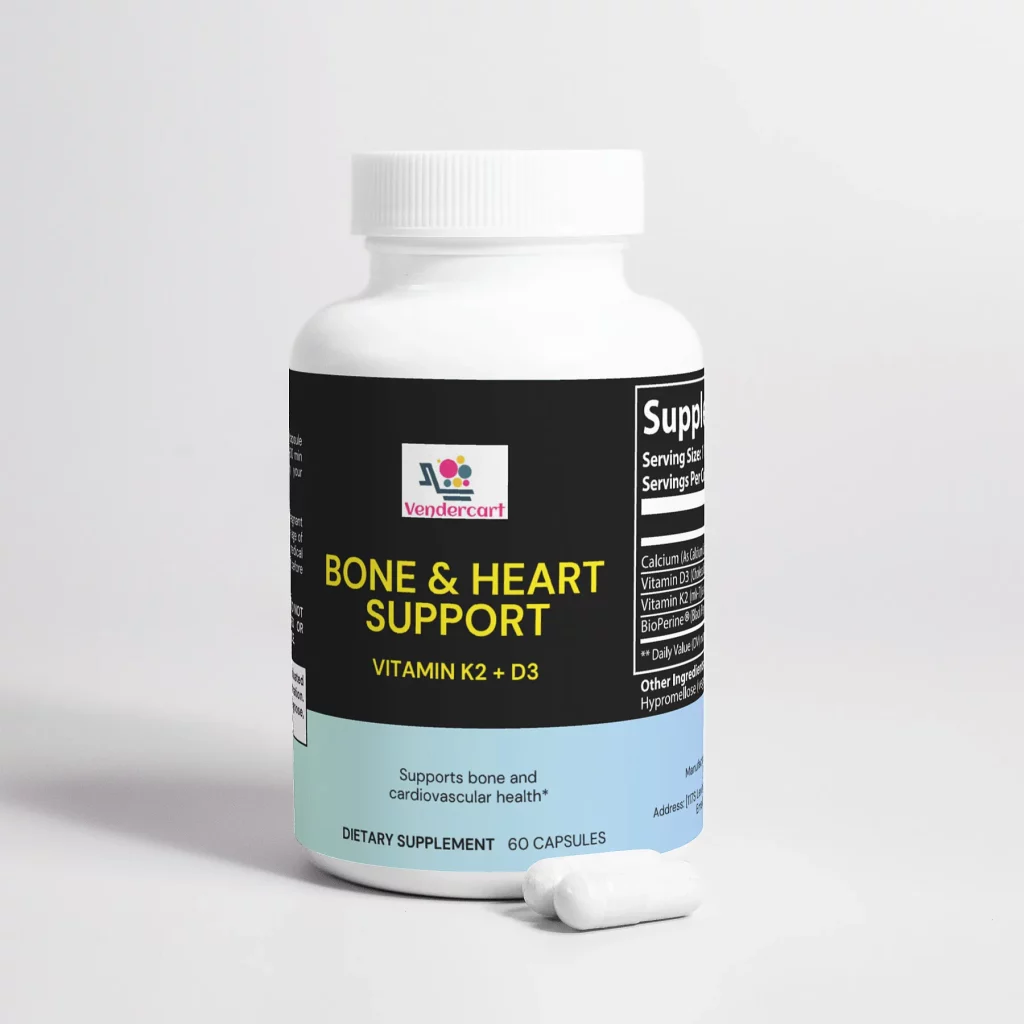
At Zenvitaco, we solved the clutter problem with our Vitamin D3 K2 for Bone & Heart Support. We combined the optimal corrective dose of Vitamin D3 (5000 IU) with the highly bioavailable Vitamin K2 (MK-7) in a single Veggie Capsule.
It’s potent, it’s plant-based, and it’s designed for the modern lifestyle. One capsule covers your bases for both bone density and heart health support.
How and When to Take D3 + K2 for Best Results
Buying the right supplement is step one. Taking it correctly is step two.
Both Vitamin D3 and K2 are fat-soluble vitamins.11 This means they do not dissolve in water; they need dietary fat to be absorbed by your body.
- The Mistake: Taking your pill with just a glass of water or black coffee on an empty stomach. You might absorb as little as 50% of the nutrient.
- The Fix: Take your capsule with your largest meal of the day, or a snack containing healthy fats like avocado, eggs, olive oil, or nuts.
Frequently Asked Questions (FAQ)
Q: Who should NOT take Vitamin D3 and K2?
Individuals taking blood-thinning medications (like Warfarin) or those with Sarcoidosis.
Explanation: Vitamin K promotes blood clotting, which can interfere with blood thinners.12 High-dose Vitamin D can also be harmful for those with hypercalcemia (high blood calcium) or specific kidney issues. Always consult your doctor if you have these conditions.
Q: Is 5000 IU of Vitamin D3 safe to take daily?
Yes, for most adults with limited sun exposure, 5000 IU is a safe corrective dose.
Explanation: Toxicology reports indicate toxicity is extremely rare below 10,000 IU daily.13 However, it is smart to get a blood test after 3-6 months of use to ensure your levels stay within the optimal range (40–80 ng/mL).
Q: Why use the MK-7 form of Vitamin K2?
MK-7 is the most bioavailable and long-lasting form of Vitamin K2.14
Explanation: Other forms, like MK-4, break down in the body very quickly (within hours). MK-7 stays active in your system for days, allowing your body to use it more efficiently to direct calcium to your bones.15
Q: Can I just get this from food?
It is nearly impossible to get 5000 IU of D3 and effective K2 from a standard diet.
Explanation: You would need to eat enormous quantities of fatty fish e
very single day to hit these D3 levels, and plates full of fermented soybeans for the K2. Supplementation is the only practical way to hit these therapeutic targets consistently.
Ready to support your bones and heart? Check out our Vitamin D3 K2 for Bone & Heart Support today.
